The full story what has happened in Norway

Steve Pepper, the former chairman of the Norwegian mirror committee SC34, tells his version of the story which led to the YES vote on OOXML:

[…] at this point, the “rules” were changed. The VP asserted that “Ecma has clearly made steps in the right direction.” The most important thing now was to ensure that OOXML came under ISO’s control so that it could be “further improved”. However, the committee was not allowed to discuss this.

The VP thereupon declared that there was no consensus, so the decision would be taken by Standard Norway.

Halfway through the proceedings, a committee member had asked for (and received) assurance that the Chairman would take part in the final decision, as he had for the DIS vote back in August. It now transpired that the BRM participants had also been invited to stay behind. 23 people were therefore dismissed and we were down to seven. In addition to Standard Norway’s three, there were four “experts”: Microsoft Norway’s chief lobbyist, a guy from StatoilHydro (national oil company; big MS Office user), a K185 old-timer, and me. In one fell swoop the balance of forces had changed from 80/20 to 50/50 and the remaining experts discussed back and forth for 20 minutes or so without reaching any agreement.

The VP thereupon declared that there was still no consensus, so the decision would be taken by Standard Norway.

The experts were dismissed and the VP asked the opinion of the Secretary (who said “Yes”) and the JTC1 rep (who said “No”).

The VP thereupon declared that there was still no consensus, so the decision would be taken by him.

And his decision was to vote Yes.

(read the full story)

After leading the committee for over 13 years, Pepper recently stepped down from his position to protest against the this farce.
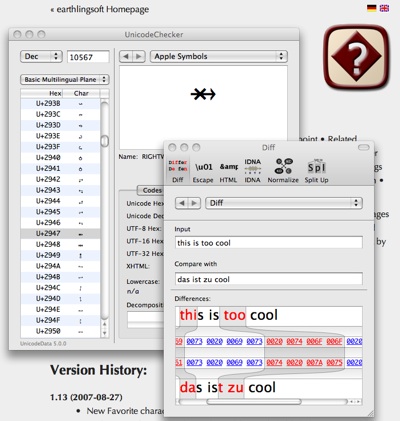
Unicode Character Tool

I’ve been looking for a Mac OS X equivalent of KDE’s kcharselect tonight and before I noticed that there is something similar already built in (the character map which is available from the internationalization menu), I stumbled upon UnicodeChecker:

UnicodeChecker

And wow, this is a very fine application which goes even beyond the options the built-in solution provides. For me the following things were particularily useful:

  • Browse the whole Unicode range by character blocks, either sorted by codepoints or by definition
  • Built-in search for character names (Spotlight indexing possible) – say, you need a character / glyph to display a triangle, just search for “triangle” in Spotlight and it opens up in UnicodeChecker!
  • Bookmarks and History of recently shown characters / codepoints
  • Conversion from/to HTML / IDNA / Javascript / CSS UTF-8/16/32 encodings – very useful if you ever stumbled across problems like how to encode a unicode string for a javascript alert() box properly
  • Splitting up unicode sequences – “Why are my textbreaks broken? Oh – must have been this non-breaking unicode space…”
  • And last but not least: a very clean interface.

So while dealing with encodings is probably not the most sexiest thing on the planet, this application surely makes it fun to browse the Unicode range.

And if you still think you don’t need this application, just check out one of the other applications the authors, Steffen Kamp and Sven-S. Porst, have created – controlling iTunes by giving your Mac notebook a slap sounds interesting as well, doesn’t it?

OOXML is through

As it was already rumored, OOXML got its official approval by ISO today. (Does ISO stand for “I Sell Out” nowadays?)

Benjamin Henrion, initiator of the OOXML campaign, notes:

Committee stuffing is a standard practice for Microsoft. Microsoft raped ISO with their office file formats, leaving the organization in limbo. The whole campaign against the format have raised an army of people, which are furious about the dirty tactics used by Microsoft to get the broken standard through ISO. This anger won’t go away, and I wish good luck to Microsoft to get it adopted by governments. The reputation of Microsoft went down below zero with this process.

(Source)

A bad day for open standards. But the war has just begun. Now that Microsoft has its ISO approval, you can bet that very aggressive lobbying in governments around the world will start, with the aim to introduce “an alternative” (read: successor) to the already widely accepted Open Document Format ODF.